- TRIBE Newsletter
- Posts
- He Left Hollywood to build a $1M Real Estate Lending Business.
He Left Hollywood to build a $1M Real Estate Lending Business.
TRIBE Newsletter — January 9th, 2026

Heather Martin
January 09, 2026
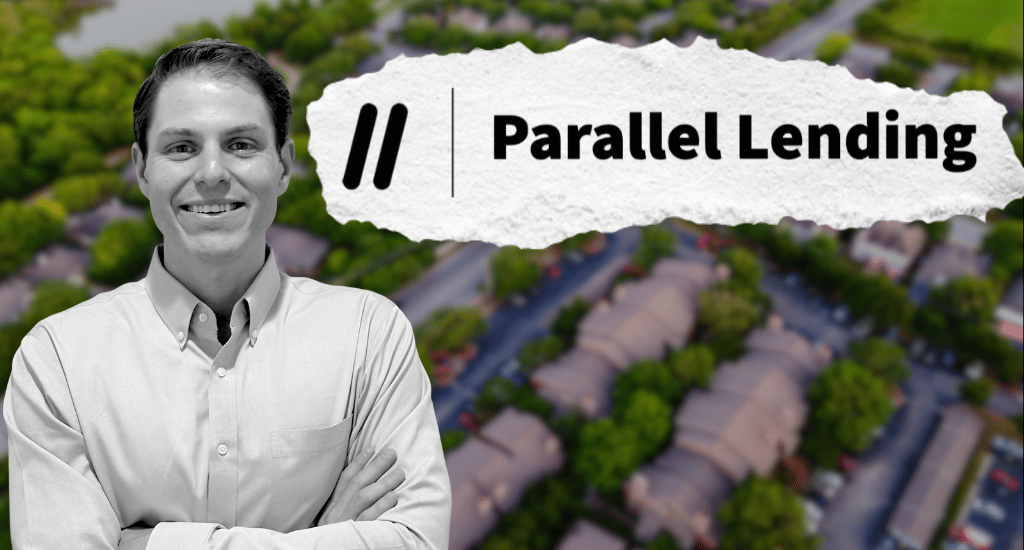
Eric Boshart left a career financing films in Hollywood and moved to Dallas to flip homes with his brother. In 2022, he took the next step and started lending instead of borrowing. Today, he runs Parallel Lending, a hard money lender in DFW that will do over $1M in revenue this year. I sat down with Eric to talk about how he got into the business, how he used Facebook as his first growth channel, and why ‘hard money’ gets a bad rap. Enjoy.
Who are you and what do you do?
I’m Eric Boshart, and I started Parallel Lending.
We’re a hard money lending firm out of the DFW Metroplex. We provide loans backed by real estate, mainly for flippers and builders.
You can think of us as a private mortgage fund. We do the funding, the origination, and the servicing in-house.
What’s your backstory, and how did you come up with the idea?
My background is in media and entertainment.
I worked at a financing firm that financed independent films through different debt instruments. Over time, it turned into a quasi private equity style business that rolled up other media companies, distribution companies, and film financiers.
It was a fun time. Los Angeles is a great place to spend your 20s. But I got burnt out.
My brother was going through his BiggerPockets era, and started investing in real estate in Fort Worth. He started having kids, and I was getting fomo.
So I started flipping homes with him while still working remote. Then, in February 2022 I left the film world.
I had expertise in credit and I had expertise in real estate. The natural next step was to combine the two and start lending against real estate instead of being the borrower.
We brought in a partner who was the catalyst. He brought in some capital, and we started doing a couple loans with people in our community.
The timing ended up being lucky. In the second half of 2022, interest rates flipped and a lot of lenders stopped lending because their cost of capital went up. Demand stayed. Supply dried up.
We stepped in at the right time and scaled pretty quickly.
Then in February 2024, about a year and a half after we started, we launched the fund so we could raise capital in a more sophisticated way and do more volume.
How did you get your first borrowers?
Our partner brought in some seed capital. Then we went where the deals were... Facebook.
Facebook is kind of the campfire where real estate investors huddle around. There are tons of DFW real estate investing groups. People post things like need financing for X, and we just respond.
Real estate is good at bringing people together since it’s a networking industry.
We also had a clear angle. We’re local. We’re private money. We’re a direct lender.
A lot of lenders are out of state, or they access financing through a bank or the capital markets. They are more of an origination funnel. They do not make the credit decisions.
We do everything. Funders, originators, servicers. We service our loans in-house throughout the life of the loan.
Our borrowers know us on a first name basis. They text me all the time. That white glove, boutique service mattered early, and it still does.
From there, word of mouth kicked in and the growth started compounding.
What’s worked to attract and retain customers?
We have two sides of the business.
One is raising capital. Attracting investors, keeping them in the fund, and continuing to raise money. That’s the hard part.
A lot of originators avoid that problem because they use someone else’s money. If we want to keep control of the fund and control every credit decision, we have to raise our own capital.
The other side is borrowers. That side is simpler.
It’s caring about their business and why they’re investing in real estate. Most of them are trying to buy their way out of a W2 and get financial freedom.
If someone worked a job, saved up $50K or $60K, and puts it into one flip, they are going to stress about it constantly. We’ve been there too.
So we try to treat their deal with the same care they do. They feel that in conversations and day to day communication.
We also advise them on whether a deal is actually good for them.
We’re like a non-bank-bank. But we want our borrowers to win so they come back.
So we’ll tell them straight. We’ll lend on it, but we don’t think it’s a good deal and we think you’re going to lose money for X, Y, and Z.
That builds trust. It also leads to a lot of repeat business.
How’s the business doing today and where do you want it to go?
Business is doing very well. We feel blessed and grateful.
It’s three partners, and we just onboarded an executive assistant, so now we’re four people.
The near term goal is to double in size in assets under management. We think we can manage that with the same team, then figure out hiring after that.
We’re focused on singles and doubles.
This is not venture capital. This is not private equity. It’s a mortgage fund.
That means we protect the downside and the growth is steady, not explosive.
Over the next three years, doubling in size feels like the right destination.
Was there ever a moment you thought this might not work?
In the beginning, every loan could destroy the business.
Now we have enough equity in the fund and enough loans that one loan will not tank us. It might impact returns, but it will not force us to wind down.
But in the first year and a half, the stress was real.
A lot of our risk is execution risk. Borrowers are not just buying and holding. They need to flip, build, renovate, or do something active with the property.
A lot can go wrong.
So we spend a lot of time underwriting the borrower, not just the numbers. We care about competence, and we care about willingness to repay, not only ability.
When we meet borrowers, we scan hard. The qualitative piece matters as much as the quantitative.
We also have strict filters. If you’re rude or you negotiate too hard, we’re not the people for you.
What do outsiders not understand about your industry?
Hard money lending has a negative connotation.
The word hard makes people think predatory. People assume the lender only cares about the asset, not the borrower.
The term comes from focusing on the hard asset instead of the soft borrower. If the borrower fails, you can take the property.
And a lot of lenders do operate that way.
Hard money lending grew after the 2007 and 2008 crisis when banks stopped lending on these residential transition loans. Private lenders stepped in, charged five points and 15 percent, provided no service, and did low leverage deals because they could.
Some were basically doing loan-to-own, so they were actually hoping the borrower failed.
There are lenders like us who care because we were investors first and we understand the stress of what borrowers are trying to do.
One more thing people miss is how rates actually work.
Everyone watches the Fed. The whole economy watches the Fed. But that has a tertiary effect on real estate rates.
Hard money rates are sticky. Thirty year fixed mortgage rates move differently and are more tied to the 10 year treasury, inflation, and expectations.
So, Fed cuts do not automatically mean mortgage rates go down. Sometimes it moves the other way.
What are your favorite tools?
G Suite for everything. Dropbox for file storage.
Slack for working with our executive assistant.
We just onboarded a third party servicing platform called Petra. It generates payoff statements, chases late payments, and produces portfolio statements every month.
And yes, Facebook. That’s still the campfire.
Favorite books or content?
I read a lot.
Lately I’ve been on a kick of books that challenge the idea that humans are hyper rational decision makers.
We live in a world of radical uncertainty. That’s also the title of one book I loved, Radical Uncertainty. One of the authors is a former Bank of England governor.
It’s about making decisions when you do not have enough information. You rely on decision frameworks you do not even realize you use.
Another one is The Origin of Wealth. The title is kind of misleading, but it introduces complexity economics. It applies complexity theory to the economy and treats it like an evolutionary process.
The idea is you tinker, you test, and the most fit solution survives. That applies to everything we do internally.
If you had to start another business, what would it be?
I’d probably be a flaneur.
Taleb talks about it in Antifragile. You take on projects as they come, you tinker, and if it stops being interesting you stop working on it.
If not that, I’d be writing screenplays.
Best advice for other entrepreneurs?
Start with the problem.
Good Strategy, Bad Strategy by Richard Rumelt is a big one for me.
Diagnose the problem in the industry you’re interested in. Then build a guiding policy around that issue and use it to create competitive advantage.
A question I try to ask a lot is what is going on here.
If you keep asking that, you start to see the truths and the myths in whatever problem you’re trying to solve.
Do not get married to your ideas. Get married to diagnosing and solving the problem.
Final Takeaways
Facebook groups can be a real distribution channel, especially in local real estate markets.
In lending, the borrower matters as much as the numbers. Willingness to repay is as important as ability.
Hard money gets a bad rap because of how it started. But hard money loans open up opportunities for small investors to access capital and build financial freedom.
When you’re small, one bad deal can wreck you. The stress of each individual loan goes down as the portfolio grows. The focus then switches to portfolio allocation.